SOLAR POWER
Solar panels convert visible sunlight to renewable electrical energy. Often confused with solar collectors used for heating water or others used for heating air, solar panels are sometimes also referred to as photovoltaic modules (PV) or solar modules. ENERGIN Ltd offer a the latest technology of SOLAR Panels, and solutions and our knowledgeable staff focuses on making it easier for you the Do-It-Yourselfer to design and decide upon the solar panel system for any project.
Before we dive in to the specifics of solar panels (a.k.a. PV modules, solar electric panels), let us remind you that energy efficiency and conservation are the best ways to reduce your energy foot print and your electrical bill. Please actively explore and incorporate all avenues of efficiency before pursuing a residential solar panel system. That being said, solar power is an exciting clean-energy option that is becoming more and more popular.
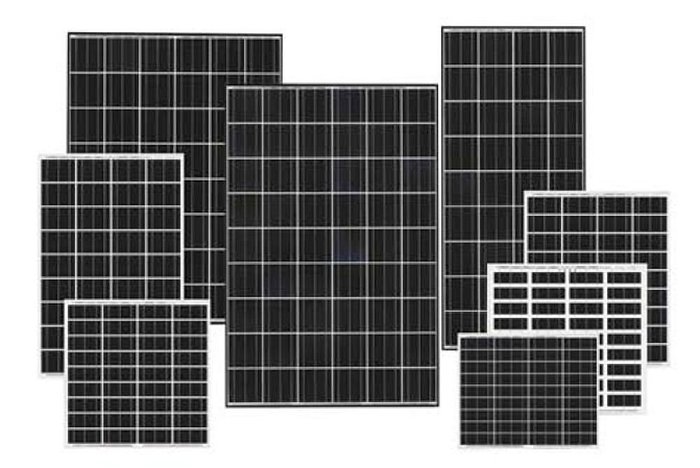
What shapes, sizes and types do solar panels come in?
Solar panels (a.k.a. Photovoltaic or PV modules) vary in length and width, and are often about 2 inches thick. They are generally about 16 kg or less. We carry a wide selection of solar panels: framed, foldable, rollable and laminates for the roof. Framed solar panels are the industry standard, most cost effective, and applicable for most home solar panels applications. Foldable Solar Panels are lightweight (less than 5 pounds) and can fold up and fit easily in a backpack. Flexible / Rollable Solar Panels are also lightweight, but bulkier than the foldable panels. Many people use these rollable panels on boats because they are durable and can be easily stowed after use. Roofing Solar Panels (laminates) are becoming more common, but are still available on a limited basis for now. Generally these thin-film laminates are more expensive per watt and require more square footage to produce the same wattage of equally sized framed module.
What size solar panels do I need and how many?
The number of solar panels you will need depends primarily upon the amount of electricity you are trying to produce and the insolation in your area. Insolation can be thought of as the number of hours in the day that the solar panel will produce its rated output. This is not equivalent to the number of daylight hours.
You'll find solar panels in a variety of wattages. Watts are the main measure of a solar panel, along with nominal voltage . For a rough idea of how many watts of solar you will need, start by dividing your electrical usage (in watt-hours per day) by the insolation in your area. Bump that number up by 30-50% (to cover system inefficiencies) and you'll have an idea of the number of watts of solar panels you will need. If that number is more than 1000 watts, you are talking about $5K or more for the solar electric system. (Could we take this opportunity to mention the importance of energy efficiency again?!) If you could still use a little help with the math, please give us a call and tell us how much electricity you are trying to produce (in kwh/month or watt-hours/ day ) and your location, and we'll help get you started.
What types of solar panels are there?
Most solar panels can be classified as monocrystalline, polycrystalline or amorphous. This is based on the silicon structure that comprises the cell. It's not quite as complicated as it sounds. Basically a 100 watt monocrystalline solar panel should have the same output as a 100 watt polycrystalline panel and a 100 watt amorphous panel. The main difference is the amount of space which the panel occupies. Because the monocrystalline structure is more efficient than amorphous in turning sunlight into electricity, the amorphous panel of the same wattage will be physically larger. By the way, when talking about efficiency of solar panels, keep in mind that solar panel efficiency is still only about 13-19% efficient in turning sunlight into electricity. Often amorphous panels are less expensive than the crystalline panels. If space is not an issue, than an amorphous panel could be a great option. Additionally, amorphous panels perform better than crystalline panels in very hot temperatures and are also slightly more tolerant of partial shading.
Locating your solar panels - very important!
A key factor in the effective use of solar electricity is proper placement of the solar panels. Make sure to locate the panels where they will receive full sunlight between the hours of 10am and 3pm. Be sure that the solar panels will not be shaded by shadows from tree branches, chimneys, other structures, etc. Once again - NO SHADE! You will be mounting the solar panels on the roof, the ground or a pole.
How long will solar panels last?
Solar electric panels use the sun's light to generate electricity. They generate electricity during sunny daylight hours and can be used in a system with batteries so that the electricity can be used at other times as well. Also known as Photovoltaic (PV) modules, solar panels are the main component of a solar electric system. (And the main expense!) Along with an inverter, mounting system, batteries and Solar Charge Controllers , solar panels can produce electricity to power the energy efficient appliances and lights and appliances in most households. Solar panels themselves generally last over 25 years, and require little maintenance. Many of the first solar panels produced in the 50s are still in use today. Many of the solar panels have a 20 year warranty or more. A common warranty states that the panels will produce at least 80% of their rated power after 20 years.
What else will I need with a solar panel?
In addition to the solar panel mounting hardware, there are additional components that you will need for a safe installation. If you plan on using just one solar panel in a battery based system, you will need a solar charge controller, and overcurrent protection to protect each major component of your system: solar panels, solar charge controller, batteries, and inverter. If you plan on using more solar panels in your system, you will also need to safely wire the photovoltaic solar panels together and to the charge controller. An easy and safe way to do this is by using MC (multi contact) connectors. This connector connects to the cables coming from the solar panel and can be cut in half to expose bare wire. Combiner Boxes are used to collect the bare ends of the wire from multiple solar panels, and then from the combiner box you can run just one set of wires to the solar charge controller. For each series string of solar panels, you will need an appropriate sized breaker.
Different Systems
Grid connected system
A grid connected system is connected to a large independent grid (typically the public electricity grid) and feeds power into the grid. Grid connected systems vary in size from residential (2-10kWp) to solar power stations (up to 10s of MWp). This is a form of decentralized electricity generation. In the case of residential or building mounted grid connected PV systems, the electricity demand of the building is met by the PV system. Only the excess is fed into the grid when there is an excess. The feeding of electricity into the grid requires the transformation of DC into AC by a special, grid-controlled solar inverter.
Standalone system
A standalone system does not have a connection to the electricity "mains" (aka "grid"). Standalone systems vary widely in size and application from wristwatches or calculators to remote buildings or spacecraft. If the load is to be supplied independently of solar insolation, the generated power is stored and buffered with a battery. In non-portable applications where weight is not an issue, such as in buildings, lead acid batteries are most commonly used for their low cost and tolerence for abuse. A charge controller may be incorporated in the system to: a) avoid battery damage by excessive charging or discharging and, b) optimizing the production of the cells or modules by maximum power point tracking (MPPT). However, in simple PV systems where the PV module voltage is matched to the battery voltage, the use of MPPT electronics is generally considered unnecessary, since the battery voltage is stable enough to provide near-maximum power collection from the PV module. In small devices (e.g. calculators, parking meters) only direct current (DC) is consumed. In larger systems (e.g. buildings, remote water pumps) AC is usually required. To convert the DC from the modules or batteries into AC, an inverter is used.
OUR PARTNER COMPANY PREVIOUS PROJECTS